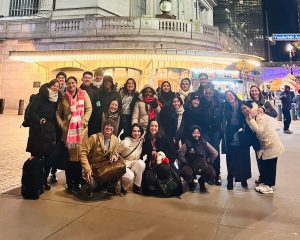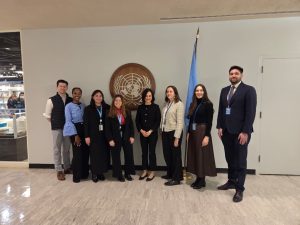
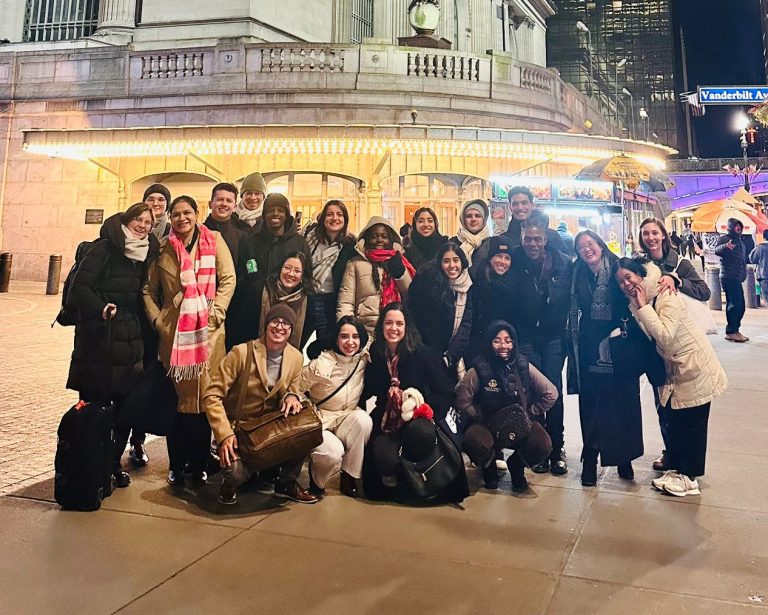
On a bitterly cold Monday afternoon in New York City, 60 young people gathered at WYA headquarters, chatting excitedly and greeting friends old and new.
The room held WYA young people from Kenya, Austria, South Africa, Croatia, Poland, Trinidad and Tobago, Argentina, Spain, Lebanon, Mexico, the Philippines, the United States, and other countries.
All were there for the same purpose—to participate in the International Solidarity Forum (ISF), a week of lectures and panel discussions on a topic of international policy, as well as UN-style negotiations to draft a declaration on personal identity and human dignity.
As WYA President Paula Lopez opened the Forum, the excitement in the room was palpable. What is personal identity? What kind of education best honors the dignity of the human person? These questions were at the heart of this year’s Forum.
Defining the Challenge
Mislav Barišić, WYA’s Director of Policy and Research, gave the first workshop on WYA’s White Paper on Sexuality Education. He painted a sobering picture of the struggles facing young people today: globally, 1 in 7 10-19 year-olds experience a mental disorder. And suicide is the third leading cause of death among 15-29 year-olds.
During COVID, there was a 25% increase in diagnoses of youth anxiety—and unfortunately, levels have remained high ever since. For the past few years, youth have reported worsening life satisfaction trends. This has far-reaching implications, since the best predictor for adult life satisfaction is subjective well-being and emotional health in childhood.
Education has a huge role to play in helping young people sort through questions of personal identity. Unfortunately, in classrooms around the world, backed by organizations such as UNESCO, IPPF, and WHO, questions of personal identity are seen only through the lens of Comprehensive Sexuality Education (CSE)—an educational program that emphasizes instruction on sexual fulfillment and pleasure, advocates for contraceptive use, access to abortion, and gender identities. This education isn’t unique to the US; elements of CSE are present in public schools around the world.
However, as we learned at this year’s ISF, despite the term ‘comprehensive’ denoting a rigorous educational program, an independent review conducted in 2019 found that out of 103 international school-based CSE studies, only 6 found evidence of effectiveness (condom use, avoidance of pregnancy or STDs, for example). Only six found evidence of effectiveness!
School-based CSE programs failed an astounding 87% of the time. And sixteen studies found instances of harmful effects by school-based CSE, such as increased sexual activity, number of partners, pregnancy, etc.
Alarmingly, as the youth mental health crisis grows, so do efforts to push CSE—and it’s a bad combination.
A Better Vision of Education
So, how to address this mental health crisis within our youth and provide a better alternative to CSE?
The good news is that research shows the most important contributors to positive youth mental health are interpersonal relationships, self-efficacy, personal growth/goal attainment, and identity/self-concept. Fortunately, there is a curriculum that addresses each of these areas: the Human Dignity Curriculum (HDC).
The HDC helps children and adolescents understand two questions: “Who am I?” and “Who can I become?” Grounded in personal identity, the Human Dignity Curriculum motivates students to recognize their inherent worth, strengthens their capacity for self-reflection and responsible choice, and build habits of excellence, in solidarity with others.
The Director of the Human Dignity Curriculum (HDC), Clare Halpine, introduced the HDC as a counterpoint to educational frameworks that undermine self-worth in young people, saying: “After taking the HDC, every student understands that human dignity has three core characteristics: it is universal (everyone has it), intrinsic (it’s a permanent part of who we are), and inalienable (no one can take it away from us). This personal value is something children and youg people want to know.”
As one attendee, also agreed: “I think the HDC gives the perfect language that gets at the heart of kids’ struggles today. They need it!” But naturally, the next question is: how do we bring this to schools and our communities?
How to Bring the HDC to the Classroom
Lord Leomer Pomperada, WYA’s Director of HDC Expansion in the Philippines, and Tamrat Belachew, who is bringing the HDC in Ethiopia, spoke to this question. Lord joined the Forum over Zoom to talk about how HDC has found success in the Philippines. He explained how WYA has been able to bring the HDC to multiple island groups and discussed plans for further growth. New research on HDC is coming down the pipeline, spearheaded by Eastern Visayas State University and other priorities include translating K-12 grades of the curriculum into Tagalog.
More good news came from Tamrat Belachew, who is bringing the HDC to his country of Ethiopia. As a country where 65% of the population in Ethiopia is under the age of 25, Tamrat explained the many challenges facing Ethiopia and how he believes a dignity-based framework can transcend ethnic reductionism and strengthen pluralism. He sees HDC as the answer to problems such as discrimination and youth instability by encouraging responsibility, personal value, creativity, and solidarity.
An Alternative Approach to Sex Education
While the HDC addresses important philosophical concepts of human dignity and identity, teens also need practical guidance on the physical and emotional changes they’re experiencing during adolescence. That’s where WYA’s partner organization, FEMM, and their health curriculum for teens comes in.
teenFEMM and teenMEN are science-based health programs for students in grades 5-9 that help adolescents understand their body and their health as they grow to full maturity. Lessons include instruction on systems of the body, the reproductive systems, how the brain controls hormones, healthy habits, and more. teenFEMM and teenMEN is a health curriculum that teaches the science of sex ed, but in an age-appropriate, your-health-is-the-focus, kind of way.
Students who have participated in the teenFEMM and teenMEN program report that they feel better about their bodies and a sense of personal agency when it comes to their health, even proactively setting goals with regards to their nutrition, exercise, sleep, and technology habits. Teens report coming away from the program feeling more confident and happy, understanding what’s happening in their bodies and how to identify biomarkers of healthy growth and development.
HDC and the teenFEMM/teenMEN program, taken together, provide a complete anthropology of the human person that sees the person as a subject with human dignity and the freedom to choose what is excellent for themselves and their body. When young people understand who they are and how amazing and interconnected the relationship is between the brain and the body, they feel more comfortable, confident and capable of achieving excellence in their life.
Speakers Share Their Wisdom
Delegates heard from many stellar speakers and panelists throughout the week, including Dr. David Walsh, a Professor of Politics from the Catholic University of America, who spoke about the importance of human relationships for personal identity. “Relationship is at the heart of what it means to be a person,” he said.
Delegates also heard from Dr. Marina Katinić Pleić, an educator and journalist from Croatia, and Kate Bierly, the Education Campaign Director at the Texas Public Policy Foundation. Both women shared their personal experiences countering CSE imposition in their respective countries. Both Kate and Dr. Pleic emphasized the importance of getting parents involved in this fight and pushing for transparency in the classroom.
Declaration Negotiations
Throughout the week, delegates absorbed insights from educators, philosophers, and advocates. But the ISF isn’t just about listening—it’s about learning to articulate and implement these ideas in real-world settings. That’s why the Declaration Negotiations are a cornerstone of the Forum.
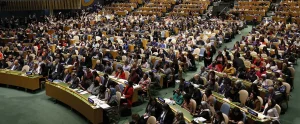
Delegates were invited to read, discuss, and propose changes to the “Zero Draft”—a rough draft of the WYA declaration on personal identity and education document. Each day, delegations would go over the language, paragraph by paragraph, discussing and voting on what to take out, what to keep in, and what to revise or edit, drawing on everything they’d learned and discussed over the course of the week. Negotiations could be intense—at times the entire room broke out in vigorous debate over just a single word—but also rewarding.
Marianne, a WYA Global Advocacy Fellow from the Philippines, said: “I really enjoyed the process because it wasn’t just about negotiation, but about finding common ground despite our different contexts. It pushed me to listen more intentionally and articulate our shared principles in a way that could bring us together. Seeing the group come together was really rewarding, and it captured what the Forum is all about: dialogue, collaboration, and building unity around human dignity.”
On the last day of the Forum, applause broke out as all the delegations reached a consensus on the final document, which was then read aloud.
Read the entire Declaration on Personal Identity and Human Dignity Education here.
A Week to Remember
Over the course of the ISF, the delegates didn’t just discuss international policy; they made new friendships that will last for years to come. Whether discussing the philosophy of the human person or exploring the streets of New York City, they connected with their peers from around the world—people from different cultures and backgrounds, but united in their desire to help youth know their own dignity and live lives of purpose.
As one participant said, “I would really like to find a way to implement the HDC in my community, and am looking into running a demo version as a summer camp. I am also passionate about bringing what I learn to the youth I volunteer with right now.”
Another delegate said, “The Forum strengthened my ability to engage in dialogue, navigate differing perspectives, and articulate my principles. More than anything, I want to help young people reflect on who they are, understand their inherent worth, and engage with others in a way that promotes authentic human dignity.”Inspired and encouraged by a week in solidarity with their peers, WYA members returned home eager to bring human dignity education to their own communities.