The vulnerability of human rights in Brazil’s military dictatorship
The military dictatorship in Brazil is the consequence of political and economic crises, and it lasted between the years of 1964 and 1985. From the coup in Castelo Branco to the long re-democratization in João Figueiredo, Brazilian history acquires deep marks in national politics and in Human Rights.
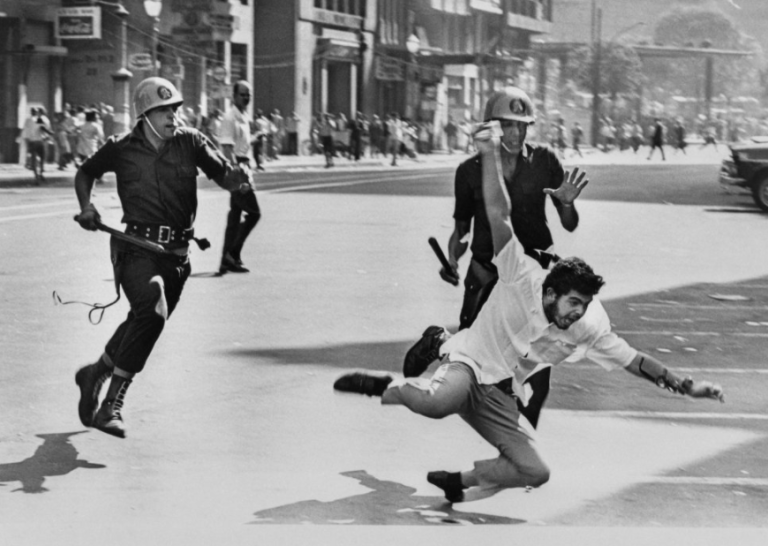
So, there are moments of greater hardening of authoritarianism, thus, the so-called “Years of Lead” points to the worst stage of national repression, between 1968 and 1974. Human rights violations permeate the practice of tortures, irregular arrests, murders, persecutions, in addition to the institutionalization of these violations.
The Institutional Acts, the 1967 Constitution, mechanisms created in favor of repression, such as the Internal Operation Detachments (DOI) and the Internal Defense and Operations Centers (CODI), crystallize the violations of Human Rights that became legal during the period. In this sense, the Collective Security reasoning, which actually did not prioritize popular well-being, abused an exacerbated nationalism to control the population and to repress resistance movements, distorting human dignity.
Instead of the state apparatus protecting national security and looking for the interests of the people, it was captured to serve the military dictatorship, a regime in which the human person is no longer protected. Hannah Arendt (2011) points out that violence destroys power and distorts the notion of social cohesion, as social rights and freedom are not allowed to people.
Thus, not all Brazilian people legitimize the regime’s authority, but they were repressed as much as possible in order to face all their rights restricted. In this sense, the Human Rights agenda in Brazil has come a long and difficult path after the dissolution of the military regime.
The Amnesty Law (1979) leads to the silencing of human rights violations, since all crimes committed in the period were forgiven. The forgetfulness supported by the Amnesty Law is still a sequel for the victims, as Brazil becomes negligent with the crimes committed by dictators and their allies through this legal apparatus.
It is essential to relate how society needs to preserve the concepts that the World Youth Alliance defends, that human dignity must be the center of public policies and forms of government. From the Human Rights violations by an authority that should protect society, the nation ceases to be valued instead of being objectified by an oppressive power project.
As the WYA Charter defends, there must be respect for the right to life in order for society to establish itself as fair and free. Therefore, we need to protect human dignity and resist the chaos of regimes that do not truly prioritize Collective Security. Brazil had to fight incessantly to survive this tough period. Although the resistance was not enough to prevent hundreds of people being murdered and thousands of people tortured, the strength of the movement allowed history not to be completely silenced.
References:
ARENDT, Hannah. Sobre a violência. Rio de Janeiro: Editora Civilização Brasileira, 2011.
Para OAB, anistia a crime de tortura é inconstitucional. Agência Câmara de Notícias, 2013. Available in: https://www.camara.leg.br/noticias/403361-para-oab-anistia-a-crime-de-tortura-e-inconstitucional
Imagens da ditadura: registros de um outro tempo. El País Brasil, 2018. Available in: https://brasil.elpais.com/brasil/2018/11/22/album/1542923865_871951.html#foto_gal_4
“Os anos de chumbo”: livro relembra horrores da ditadura militar. Galileu, 2020. Available in: https://revistagalileu.globo.com/Sociedade/Historia/noticia/2020/03/os-anos-de-chumbo-livro-relembra-horrores-da-ditadura-militar.html
História da Ditadura. Memórias da ditadura. Available in: ttp://memoriasdaditadura.org.br/
Human Rights Watch: ditadura no Brasil torturou 20 mil pessoas; 434 foram mortas ou desapareceram. Estadão, 2019. Available in: https://politica.estadao.com.br/noticias/geral,human-rights-watch-ditadura-no-brasil-torturou-20-mil-pessoas-434-foram-mortas-ou-desapareceram,70002770377
Published: November 12, 2021
Written by Anni Barreto, Project Management Intern for the World Youth Alliance Latin America.