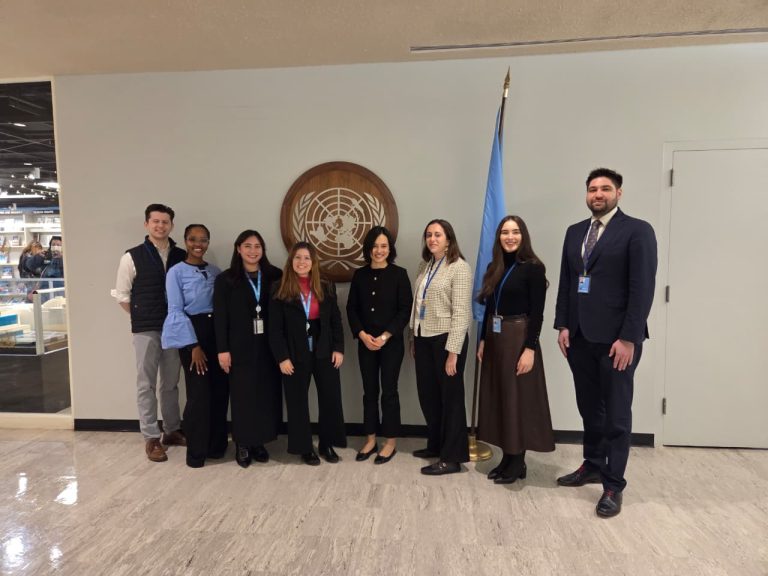
By: WYA Advocacy Fellows
On the first day of the 70th Commission on the Status of Women (CSW70), shortly following the lunch recess, the Chair, Maritza Chan Valverde, Ambassador of Costa Rica to the UN, declared that the Agreed Conclusions draft that had been circulated in the early hours of that day had been sufficiently negotiated to merit its designation as the consensus of the Commission.
Typically, a negotiation process unfolds during the main event of the CSW, over a two-week period, culminating in the Agreed Conclusions outcome document by the final week of the Commission. This time, two rounds of closed-door negotiation meetings took place before the official CSW event. And when the “Chair’s final draft” was communicated to all delegations, several expressed disagreement with the language. However, their concerns were not addressed in the last version that was circulated just before midnight on Sunday, the eve before the document was proposed for adoption by the Chair.
This marks a disappointing, but now-familiar, opaque and undemocratic trend following the COVID-19 pandemic. At CSW64, during the early days of 2020’s COVID-19 lock downs, a pre-negotiated political declaration was adopted without real-time negotiation, online or otherwise. In the years that followed, the “negotiations process” has been “completed” ahead of the Commission itself.
In practice, this turns the 2 weeks of the Commission into a performative display by governments and NGOs. Question, discussion, debate or dissent is irrelevant when the “Agreed Conclusions” document is “resolved” before the Commission begins. The re-framing of the adoption process from a negotiation to a procedural matter, destroys the diplomatic practice of consensus building. So, why is this “lazy-fair” option continuing to trend? The new procedure is far less transparent, as decisions are made behind closed doors.
The United States delegation, represented by Ambassador Dan Negrea, stated that it was unable to accept the draft, arguing that the “agreed conclusions” had been reached in a meeting at which no US representative was present. Further, the US delegation had expressed fundamental objections to language contained in the draft and this had been ignored. Citing Article 11 of E/RES/2022/4, which requires documents bearing the title “agreed conclusions” to reflect negotiations open to all delegations and the delegation’s subsequent agreement with the language used, the US stated that the draft could not properly carry that designation. The US called on the Commission to re-open the document for negotiation, ensuring that all delegations had the opportunity to participate in shaping the text and to agree with its language.
The Chair overruled this objection. This decision was met with an uproar on the floor. Having been denied the reopening of negotiations, the US delegation felt coerced into engaging the proceeding on the Chair’s terms.
As the Commission deemed all paragraphs to have reached sufficient consensus in the negotiations and thus to be closed, the US had no choice but to propose a number of formal amendments to be voted on separately. Here are a few:
- Define the term “gender” in paragraph 1 to indicate that it refers to men and women.
- Qualify “review conferences” in paragraph R by adding “adopted by the General Assembly” to ensure that references to sexual and reproductive health and reproductive rights do not extend to abortion, to ambiguous understandings of “gender,” and child sexual autonomy.
- Qualify “sexual and reproductive health and rights” in paragraph Z by adding “in accordance with national laws and policies” for the same reason stated above. (Note: this term is widely understood to imply that abortion should be considered a fundamental right. To learn more, you can read the WYA White Paper on Reproductive Health.)
- Delete the reference “to address disinformation, misinformation, and hate speech,” on the grounds that these terms are used to vitiate freedom of speech.
- Replace “balance” in the phrase “to achieve gender balance at all levels of public governance and justice-related functions” with “to achieve equality and the empowerment of all women and girls” in paragraph H.
Having exhausted its procedural options, the US requested a recorded vote on the draft text. After several delegations explained their positions, the vote concluded with an adoption by vote of the Agree Conclusions: 37 in favor, 6 abstentions, and 1 against. For the first time ever, the CSW outcome document was adopted not by consensus, but by a majority vote. And while other delegations explained their vote and their strong reservations against some terms and concepts present in the Agreed Conclusion, in the end the US was the only CSW Member State to vote against them.
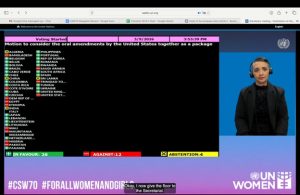
Screenshot: UN WebTV
The Chair then brought the consolidated amendment to a vote. With a final tally of 26 against, 1 in favor, and 14 abstentions, all eight proposals were struck down at once. The delegations that abstained were not authorized to vote for every US amendment individually. Thus if they did not agree with any of the amendments, they in fact voted against all of them. This was explicitly affirmed by the delegations of Nigeria, Egypt and Pakistan, who voted “abstain” on the amendments assembled as a whole.
When the Commission seeks adoption by consensus, veto power rests with every individual delegation, at least theoretically. However, since the document was to be adopted by vote, the power resided with the Bureau of the Commission – by controlling the order procedural motions would be applied– and the majority, through numerical supremacy.
Under these conditions, changes to the document could no longer be submitted, except as formal amendments requiring a majority vote to get to the floor. This year’s conclusions will forever have an asterisk next to the word “agree”. The legitimacy of this year’s Agreed Conclusions document now faces significant scrutiny since it was not adopted by consensus.
Conclusion
The specious claim reiterated by the Chair and multiple delegations that sufficient time was given to negotiate the draft text and that these negotiations had universal assent before the Commission commenced was refuted by multiple delegations directly.
The United States’ example, reinforced by the statements of delegations that abstained from the vote, offered ample evidence that consensus had not been attained.
Moreover, delegations clearly lacked adequate time and opportunity for in-depth deliberation and negotiation, as the Chair’s final draft of the Agreed Conclusions was circulated at midnight before the morning of the vote, and no paragraphs were opened for on the floor negotiation. Further, participation from civil society was greatly restricted due this process.
This faulty procedure culminated in a problematic precedent which in no way reflects consensus. The weight of the ensuing document, and future negotiations relating to it, will need to evaluate what took place this year.
However, there is hope. We cannot overlook the mode of adoption. Since the Agreed Conclusions document was adopted by vote, this nullifies the claims that all the language within the document is the result of a broad UN consensus. The World Youth Alliance advocacy team continues its on the ground presence at the UN to advocate for human dignity and universal human rights of everyone, from conception until natural death, as well as reporting on the important events of the 70th Commission of Status of Women.
WYA Advocacy team
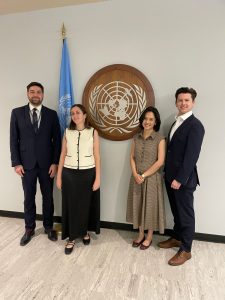
WYA advocacy team at the UN Commission on the Status of Women